
Digital marketing uses online channels such as websites, search engines, social media, email, video, and paid ads to reach customers. Traditional marketing uses offline channels such as television, radio, newspapers, brochures, billboards, events, and direct sales.
For most businesses in Nepal, the right answer is not “digital marketing vs traditional marketing” as a fight. The better question is: which channel helps your audience trust you, find you, and take action at the right time?
In many cases, a combined strategy works best. Digital channels are measurable, flexible, and useful for targeting. Traditional channels still build awareness, local trust, and visibility among people who may not be highly active online.
BaAma Consultant Service provides sales training, placement, and digital marketing solutions, with experience in healthcare and pharmaceutical industries in Nepal. This gives the topic practical relevance for businesses that need both trust and reach.
What Is Digital Marketing?
Digital marketing is the promotion of products, services, brands, or ideas through online platforms and digital technologies.
It includes channels such as:
- Search engine optimization
- Social media marketing
- Paid online advertising
- Content marketing
- Email marketing
- Website optimization
- Video marketing
- Online reputation management
- Analytics and conversion tracking
In simple words, it helps a business appear where customers already search, scroll, watch, compare, and make decisions.
For example, a clinic in Lalitpur may use Google search visibility to appear when someone searches “best dermatologist near me.” A training company may use Facebook and YouTube content to educate students. A pharmaceutical distributor may use LinkedIn, email, and landing pages to reach professional buyers.
Digital promotion is especially useful when people need information before contacting a business.
What Is Traditional Marketing?
Traditional marketing refers to offline marketing methods used before the rise of internet based promotion.
Common examples include:
- Television ads
- Radio ads
- Newspaper ads
- Magazine placements
- Flyers and brochures
- Billboards
- Hoarding boards
- Sponsorships
- Events and exhibitions
- Direct sales visits
Traditional methods are still relevant in Nepal because not every customer is fully online. Some people trust local presence, print materials, personal meetings, or familiar media channels more than internet ads.
For businesses that depend on geography, reputation, or community trust, traditional marketing can still support brand recall.
Digital Marketing in Nepal: Why This Comparison Matters Now
Nepal’s customer behavior is changing, but the market is still mixed.
DataReportal reported that Nepal had 16.6 million internet users by October 2025, with internet penetration at 56%. It also reported 14.8 million social media user identities, equal to about 50% of the population. At the same time, around 13 million people were still offline, which means businesses should not ignore offline audiences.
This creates a practical lesson: online marketing is growing, but traditional touchpoints still matter.
A restaurant in Kathmandu may get customers from TikTok videos, Google Maps, and Instagram reels. But a hospital, school, real estate company, or pharmaceutical brand may still need offline trust-building through seminars, local referrals, printed materials, and sales representatives.
That is why the best marketing strategy in Nepal often depends on three things:
- Who the customer is
- Where the customer spends attention
- How much trust the customer needs before taking action
Digital Marketing vs Traditional Marketing: Main Differences
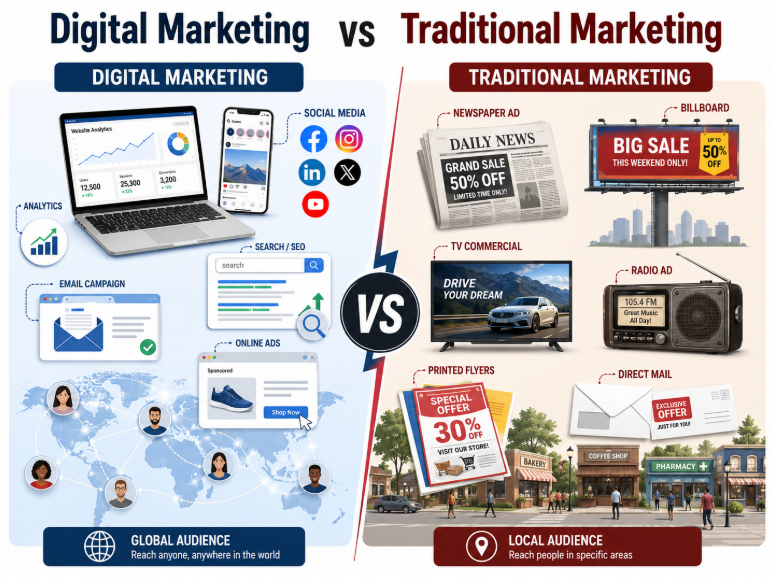
| Factor | Digital Marketing | Traditional Marketing |
| Main channels | Google, websites, social media, email, video, online ads | TV, radio, newspapers, billboards, flyers, events |
| Targeting | Can target by interest, search intent, location, behavior | Usually broader targeting |
| Measurement | Clicks, leads, calls, traffic, conversions can be tracked | Harder to measure accurately |
| Cost control | Budgets can start small and scale | Usually needs higher upfront cost |
| Speed | Campaigns can be edited quickly | Changes take more time |
| Trust factor | Builds trust through content, reviews, website, case studies | Builds trust through visibility, familiarity, physical presence |
| Best for | Lead generation, education, remarketing, search visibility | Mass awareness, local presence, brand recall |
| Limitation | Needs skills, consistency, platform knowledge | Less precise tracking and targeting |
The biggest difference is measurability. With online marketing, a business can often see which campaign brought traffic, calls, messages, or leads. With offline campaigns, results are usually estimated through sales changes, coupon codes, customer surveys, or location-based tracking.
Which Is More Cost-Effective?
Digital marketing is often more cost-effective for small and medium businesses because it allows controlled testing.
A business can start with a small budget, test different messages, analyze performance, and improve the campaign. For example, a training institute can run two ad versions and see which one brings more inquiry forms.
Traditional marketing can be effective, but it usually requires larger initial investment. Printing, radio slots, billboard rental, and event sponsorships may not be easy to test in small amounts.
However, “cheaper” does not always mean “better.”
A billboard near a hospital area may be useful for a healthcare-related brand. A radio message may work for rural awareness. A printed brochure may support a medical representative’s meeting.
The best choice depends on the business goal.
When Digital Marketing Works Better
Online marketing works better when customers actively search or compare options.
It is useful for businesses that want:
- More website traffic
- More phone calls or form submissions
- Better Google visibility
- Social media engagement
- Online reputation building
- Local SEO presence
- Measurable lead generation
- Retargeting previous visitors
For example, people often search online before choosing a doctor, training course, consultant, restaurant, school, software provider, or agency.
This is where SEO, content, Google Business Profile optimization, reviews, and helpful blog posts can influence decisions.
A digital marketing agency in Nepal can also help businesses understand audience behavior, keyword demand, content gaps, and conversion data.
When Traditional Marketing Works Better
Traditional marketing works better when physical presence and repeated visibility matter.
It is useful for:
- Local brand awareness
- Public campaigns
- Events and launches
- Rural or semi-urban audiences
- Community-based trust
- Trade marketing
- Mass communication
- High-touch B2B sales
For example, a pharmaceutical company may still depend on field representatives, printed product information, doctor meetings, and conferences. A local school may still benefit from banners, community events, and referral networks.
Traditional marketing is also helpful when the product needs explanation in person or when the audience is not highly active online.
Why a Hybrid Strategy Often Works Best in Nepal
A hybrid strategy combines the strengths of both methods.
For example:
A healthcare brand may use seminars and doctor networking offline, while also using SEO, educational blogs, and social media videos online.
A training company may use school visits and printed brochures, while also running Facebook ads and publishing career-focused content.
A retail business may use local signage and events, while also improving Google Maps visibility and Instagram content.
This approach reduces risk. Businesses should not rely only on one channel.
Nepal’s brief social media platform restrictions in September 2025, which were later lifted, showed that platform dependency can affect communication. For businesses, this is a reminder to build owned assets such as websites, email lists, customer databases, and search visibility.
Digital Marketing Channels Every Business Should Understand
1. Search Engine Optimization
SEO helps your website appear on Google when people search for relevant topics.
For example:
- “digital marketing agency in Nepal”
- “sales training in Nepal”
- “healthcare marketing Nepal”
- “best business consultant in Lalitpur”
SEO is not only about ranking. It is about answering the searcher’s question better than competing pages.
Google recommends creating helpful, reliable, people-first content rather than content made only to manipulate rankings.
A good SEO strategy includes keyword research, technical website improvement, useful content, internal links, page speed, local SEO, and trust signals.
2. Content Marketing
Content marketing means creating useful content that educates the audience.
Examples include:
- Blog posts
- Guides
- Case studies
- Infographics
- Videos
- FAQs
- Checklists
- Service pages
For BaAma Consultant, useful topics could include healthcare marketing, sales team training, digital skills, brand communication, and business growth strategies in Nepal.
Content builds trust because it helps people before asking them to buy.
3. Social Media Marketing
Social media marketing uses platforms such as Facebook, Instagram, LinkedIn, TikTok, and YouTube to connect with audiences.
It works well for visibility, education, community engagement, and remarketing.
But social media should not be the only strategy. Algorithms change. Reach can drop. Platforms can face policy issues.
A smart approach is to use social media to bring people toward owned channels such as a website, email list, consultation form, or phone call.
4. Paid Advertising
Paid ads include Google Ads, Meta Ads, YouTube Ads, and other sponsored placements.
They can produce faster visibility than SEO, but they need careful budget control.
Paid ads work best when the business has:
- A clear offer
- A strong landing page
- Good tracking
- Defined audience
- Follow-up process
- Realistic budget
Without these, ad spending can increase without producing quality leads.
5. Email and CRM Marketing
Email marketing is useful for nurturing leads and maintaining relationships.
It is not only for e-commerce. Training companies, consultants, clinics, and B2B businesses can use email to send updates, educational content, event invitations, and follow-up messages.
The key is permission. Businesses should send helpful and relevant messages to people who agreed to receive them.
6. Online Reputation Management
Reputation is important in Nepal, especially for healthcare, education, consulting, and professional services.
Online reputation includes:
- Google reviews
- Testimonials
- Case studies
- Social media comments
- Brand mentions
- Response quality
- Accuracy of business information
A business should not fake reviews or make exaggerated claims. Trust is built through real service quality and transparent communication.
Traditional Marketing Channels That Still Matter
Print Materials
Brochures, flyers, product leaflets, and catalogs still support offline sales conversations.
They work best when the design is clean and the message is clear.
Radio and Television
Radio and TV can support awareness campaigns, especially for broad audiences.
They are less precise than online ads but can create familiarity.
Outdoor Advertising
Billboards and banners are useful in high-traffic locations.
They work best when the message is short, memorable, and location-relevant.
Events and Sponsorships
Events help build direct relationships.
For healthcare, pharmaceuticals, education, and consulting, events can create credibility because people interact face-to-face.
Direct Sales and Field Visits
Direct sales remains important in Nepal, especially for B2B, pharmaceutical, institutional, and professional services.
Digital tools can support sales teams through presentations, CRM systems, landing pages, and follow-up content.
How to Choose Between Digital and Traditional Marketing
Use this simple decision table.
| Business Goal | Better Starting Point |
| Generate leads from people searching online | Digital marketing |
| Build local awareness in a specific area | Traditional + local SEO |
| Educate customers before purchase | Content marketing |
| Reach rural audiences with low internet use | Traditional marketing |
| Track return on ad spend | Digital marketing |
| Build trust for professional services | Hybrid strategy |
| Promote an event | Social media + offline promotion |
| Support field sales | Brochures + digital presentations + CRM |
The practical answer is usually not one channel. It is the right mix.
Start with the audience, not the platform.
Digital Marketing for Healthcare and Professional Services
Healthcare, pharmaceuticals, education, and consulting need more careful marketing than simple retail products.
People expect accuracy, ethics, and trust.
For these sectors, businesses should avoid:
- Misleading claims
- Fear-based messaging
- Fake urgency
- Unverified health promises
- Overpromising results
- Using testimonials irresponsibly
Instead, they should focus on:
- Educational content
- Clear service information
- Qualified expert input
- Transparent contact details
- Real patient or client guidance where appropriate
- Compliance with local rules
- Respectful communication
This is where E-E-A-T matters. Experience, expertise, authoritativeness, and trust are not just SEO concepts. They are practical requirements for businesses that affect people’s decisions.
Benefits of Digital Marketing
Digital channels offer several practical benefits.
Better Targeting
You can reach people based on search behavior, location, interest, age group, or previous website activity.
Measurable Results
You can track traffic, calls, messages, forms, bookings, and conversions.
Faster Testing
You can change headlines, visuals, budgets, and landing pages quickly.
Local Search Visibility
For Nepali businesses, Google Maps and local SEO can bring high-intent customers.
Long-Term Value
SEO content can keep bringing visitors after publication, especially when it is updated and useful.
Limitations of Digital Marketing
Digital promotion also has limits.
It needs skill, consistency, content quality, and tracking. Running ads without strategy can waste money.
Competition is also increasing. Many businesses now post on social media, but few create genuinely useful content.
Another limitation is trust. A professional-looking ad may get attention, but trust comes from proof, clarity, reviews, and service quality.
Digital marketing should not be treated as a shortcut. It works best when connected with real business operations.
Benefits of Traditional Marketing
Traditional marketing still has value.
It can create broad awareness, physical visibility, and familiarity. It is especially useful for audiences who are less active online.
Offline marketing also supports relationship-based selling. In Nepal, many business decisions still happen through meetings, referrals, and personal trust.
Traditional methods can also make a brand feel more established, especially when combined with a strong online presence.
Limitations of Traditional Marketing
Traditional marketing is harder to measure.
A business may know that sales increased after a radio campaign, but it may not know exactly which message or placement caused the result.
It can also be expensive to change. Once brochures are printed or a billboard is installed, mistakes are harder to fix.
Traditional marketing can create awareness, but it usually needs digital support to capture leads and continue the conversation.
Practical Marketing Plan for a Nepali Business
Here is a simple hybrid plan for a small or medium business in Nepal.
Month 1: Build the Foundation
Create or improve the website. Set up Google Business Profile. Add clear service pages, contact information, location, and trust signals.
Month 2: Publish Helpful Content
Write blogs that answer customer questions. Add FAQs. Create short videos from the same topics.
Month 3: Start Local Promotion
Use flyers, local partnerships, events, or banners where relevant. Connect offline promotion to QR codes, website links, and phone numbers.
Month 4: Run Small Paid Campaigns
Test Google Ads or Meta Ads with a limited budget. Track inquiries, not just likes.
Month 5: Improve Based on Data
Check which pages, keywords, posts, and ads bring leads. Stop weak campaigns and improve strong ones.
Month 6: Build Retention
Use email, WhatsApp follow-ups, CRM, customer education, and review requests.
This plan is realistic because it starts with basics before spending heavily on ads.
Common Mistakes Businesses Make
Many businesses in Nepal make the same marketing mistakes.
They post randomly without a strategy. They run ads without a landing page. They copy competitors instead of understanding customers. They focus on likes instead of leads. They ignore Google search. They do not track calls or inquiries.
Another mistake is choosing digital or traditional marketing based on personal preference.
The right choice should come from customer behavior.
If customers search on Google, invest in SEO. If they need face-to-face trust, use events and sales visits. If they compare options on social media, create educational content. If they need repeated recall, use offline visibility.
Role of a Digital Marketing Agency in Nepal
A digital marketing agency in Nepal can help businesses plan, execute, and measure online campaigns.
A good agency should help with:
- Keyword research
- Website strategy
- SEO
- Content planning
- Social media campaigns
- Paid ads
- Lead tracking
- Reporting
- Conversion improvement
- Local market understanding
However, businesses should choose an agency carefully.
Look for clear communication, realistic expectations, transparent reporting, and understanding of your industry.
For sectors such as healthcare, pharmaceuticals, education, and consulting, industry understanding is especially important because trust and accuracy matter.
Final Verdict: Digital Marketing vs Traditional Marketing
Digital marketing is better for measurable growth, search visibility, targeted advertising, content education, and lead generation.
Traditional marketing is better for mass awareness, local presence, personal relationships, and audiences that are not fully online.
For most Nepali businesses, the best strategy is a balanced one.
Use digital channels to be found, educate customers, measure demand, and generate leads. Use traditional channels to build familiarity, trust, and offline relationships.
The strongest marketing strategy is not the one that follows trends. It is the one that matches the customer journey.
FAQs
What are the 4 types of digital marketing?
The four common types of digital marketing are SEO, social media marketing, content marketing, and paid advertising. Other important types include email marketing, video marketing, affiliate marketing, and online reputation management.
What exactly is digital marketing?
Digital marketing is the promotion of a business, product, service, or brand through online channels such as Google, websites, social media, email, mobile apps, and digital ads.
How do beginners start digital marketing?
Beginners can start digital marketing by learning the basics of SEO, social media, content writing, paid ads, analytics, and customer behavior. The best first step is to practice on a website, blog, small business page, or personal project.
What skills do I need for digital marketing?
You need skills in communication, writing, research, SEO, social media, data analysis, basic design, advertising, content planning, and customer understanding. Strategic thinking and consistency are also important.
Is digital marketing a good career?
Yes, digital marketing can be a good career because businesses need online visibility, content, ads, analytics, and lead generation. Career growth depends on practical skills, portfolio quality, continuous learning, and the ability to produce measurable results.
Author Bio
Written by BaAma Consultant Service
BaAma Consultant Service is a Nepal based digital marketing company working with businesses, professionals, and organizations to improve communication, visibility, and growth. The team focuses on practical strategies that connect digital tools with real business outcomes.