
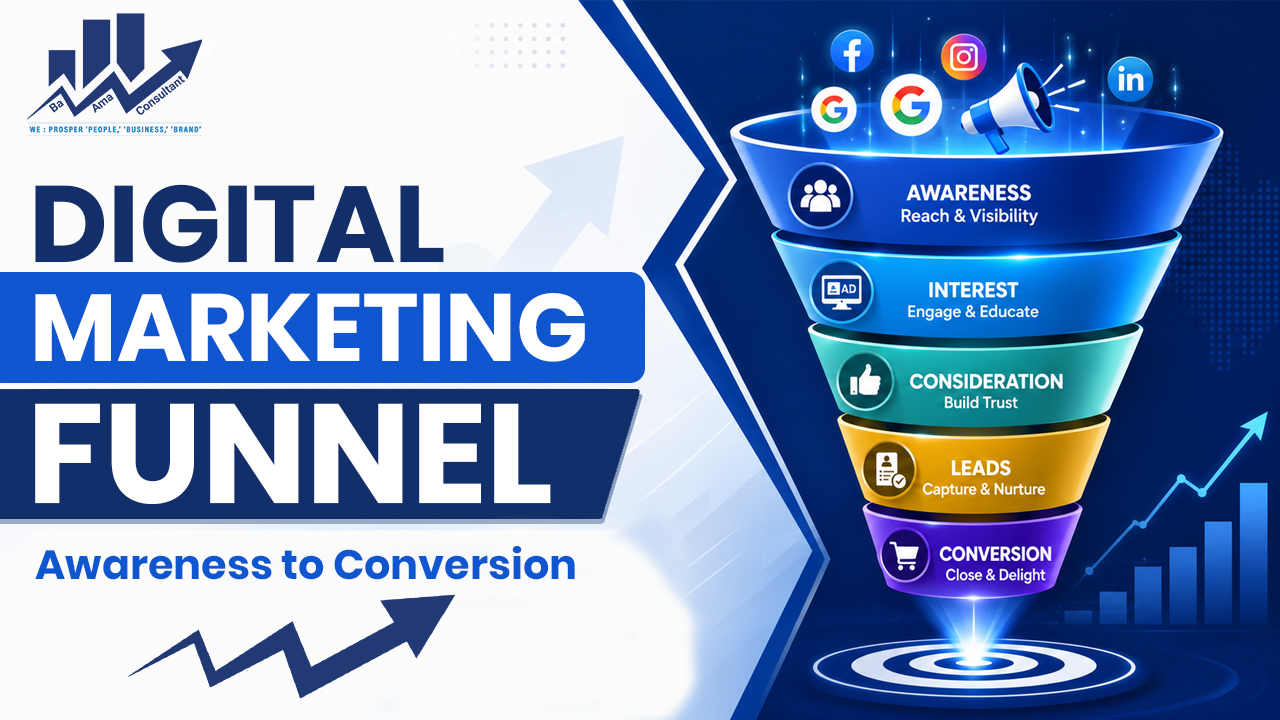
By Digital Marketing Experts of BaAma Consultant Service Pvt. Ltd.
Last updated: July 2026
A digital marketing funnel is the journey people take from first discovering your brand to becoming a customer and ideally, a repeat customer.
It is not just about running Facebook ads, posting on Instagram, or ranking on Google. A strong funnel connects digital marketing, social media marketing, search engine optimization, content, paid advertising, landing pages, follow-up, and customer service into one measurable system.
For example, someone may first see your educational video on Facebook, search your business on Google, visit your website, read reviews, send a message, and finally book a consultation or make a purchase.
That complete path is your digital marketing funnel.
What Is a Digital Marketing Funnel?
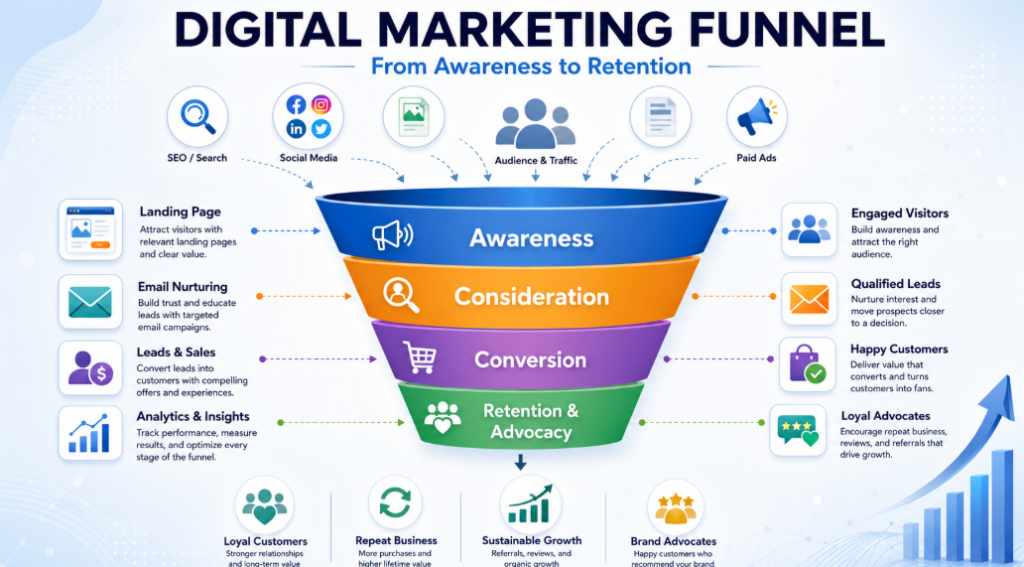
A digital marketing funnel is a structured process that guides potential customers through four main stages:
- Awareness – People discover your brand or solution.
- Consideration – They compare, research, and evaluate options.
- Conversion – They take a valuable action, such as calling, buying, booking, or submitting a form.
- Retention and Advocacy – They return, recommend, review, or buy again.
The goal is not to push every visitor to buy immediately. The goal is to give the right information, message, and next step at the right stage of their decision-making journey.
Why Does a Digital Marketing Funnel Matter?
Many businesses invest in ads or social media but do not see consistent inquiries or sales.
Often, the issue is not the platform. The issue is the missing journey between attention and action.
A person who sees your first video may not be ready to buy today. They may need proof, useful information, pricing clarity, reviews, a consultation, or reassurance before contacting you.
A funnel helps a business answer practical questions:
- How do people first discover us?
- What information do they need before trusting us?
- What makes them contact or purchase from us?
- Where are we losing potential customers?
- How do we encourage existing customers to return or refer others?
For businesses investing in digital marketing in Nepal, a funnel replaces random posting with a clearer growth system.
The 4 Stages of the Digital Marketing Funnel
| Funnel Stage | Customer Mindset | Main Goal | Useful Marketing Channels | Key Metric |
|---|---|---|---|---|
| Awareness | “I have a problem or need.” | Reach the right audience | SEO, social media, video, PR, ads | Reach, impressions, website visits |
| Consideration | “Which option should I choose?” | Build trust and relevance | Blogs, case studies, reviews, email, retargeting | Engagement, time on page, leads |
| Conversion | “Should I take action now?” | Generate inquiry, booking, or sale | Landing pages, offers, calls, WhatsApp, remarketing | Leads, sales, bookings, conversion rate |
| Retention | “Was this a good choice?” | Encourage loyalty and referrals | Follow-up, email, customer support, community | Repeat business, reviews, referrals |
Stage 1: Awareness : Help the Right People Discover You
The awareness stage is where people first come across your brand.
They may not know your company name yet. They may only know their problem, need, or goal.
For example, a business owner may search:
- “digital marketing agency in Nepal”
- “SEO expert in Nepal”
- “social media marketing for clinics”
- “how to grow a small business online”
- “best way to get leads from Facebook”
At this stage, your content should answer real questions instead of pushing a hard sales message.
Awareness Content That Works
Useful awareness-stage content may include:
- Search engine optimized blogs
- Social media reels and educational posts
- Short videos explaining common problems
- Infographics and carousels
- Google Business Profile content
- Expert interviews
- Industry-specific guides
- Awareness campaigns and topical posts
For example, a healthcare company may publish a blog about patient education. A training institute may create content about career growth. A restaurant may produce short food videos and local search content.
The focus should be simple: help people understand the problem before asking them to purchase.
Search engine optimization services are especially useful at this stage because they help businesses appear when people are actively looking for answers, services, or local providers.
Awareness Stage Example
A clinic wants more consultations for a new service.
Instead of immediately publishing “Book Now” graphics every day, it can create content such as:
- What are the common symptoms?
- When should you consult a specialist?
- What happens during the procedure?
- What questions should patients ask before treatment?
- How can early action improve planning and care?
This approach builds visibility and trust before the customer is ready to inquire.
Stage 2: Consideration : Build Trust Before Asking for Action
At the consideration stage, people already know they have a need. Now they compare options.
They may visit multiple websites, check social media pages, read Google reviews, compare service details, ask friends, or send messages to several businesses.
This is where many brands lose potential customers.
A business may get attention through ads or viral content but fail to explain why the customer should choose them.
What Customers Want During Consideration
Customers commonly look for:
- Clear service information
- Transparent process
- Professional expertise
- Reviews or testimonials
- Case studies
- Pricing guidance or consultation details
- Location and contact information
- Response speed
- Evidence of experience in their sector
For a digital marketing agency in Nepal, the consideration stage may include explaining service packages, process, industries served, reporting methods, and expected timelines.
BaAma’s social media marketing service reflects this funnel stage through audience research, content development, social media advertising, management, and reporting.
Consideration Content Ideas
Use content that reduces uncertainty:
- “How our SEO process works”
- “What is included in social media management?”
- “SEO vs paid ads: which is right for your business?”
- Client testimonials
- Before-and-after campaign improvements
- Frequently asked questions
- Service comparison pages
- Free consultation or audit offers
- Downloadable checklists or guides
The customer does not need more noise. They need clearer reasons to trust you.
Stage 3: Conversion : Make the Next Step Easy
Conversion does not always mean a completed purchase.
Depending on your business, a conversion can be:
- A phone call
- A WhatsApp message
- A consultation booking
- A website form submission
- A product purchase
- A demo request
- A store visit
- An event registration
- A quotation request
At this stage, your job is to remove friction.
A customer should not have to search for your number, wonder what to do next, or wait several days for a reply.
Conversion Elements That Improve Results
A strong conversion page or campaign should include:
- One clear call to action
- Simple contact options
- Mobile-friendly design
- Fast-loading page experience
- Clear service benefit
- Trust signals, such as testimonials or credentials
- Simple form fields
- Location and working hours
- Quick sales or support follow-up
For example, instead of saying:
“Contact us for more details.”
Use:
“Book a 30-minute digital marketing consultation to identify your biggest growth opportunity.”
This tells the customer what they will receive and what action to take.
Businesses can direct leads to BaAma’s contact page when they are ready to discuss SEO, social media, content, branding, or broader business growth support.
Stage 4: Retention and Advocacy : Keep the Relationship Growing
A funnel should not end after the first sale.
The most valuable customers are often the ones who return, refer others, leave a review, or become long-term clients.
Retention marketing includes:
- Follow-up messages
- Customer onboarding
- Educational email content
- Loyalty offers
- Review requests
- Referral campaigns
- Post-purchase support
- Community building
- Regular performance reporting
For service businesses, retention is especially important.
A client who receives clear reports, proactive recommendations, and good communication is more likely to continue working with the agency.
For product-based businesses, retention may involve reminders, repeat-order offers, subscription plans, customer support, or relevant recommendations.
How to Build a Digital Marketing Funnel for Your Business
A useful funnel starts with business goals, not with a random content calendar.
Step 1: Define One Main Business Goal
Choose the action that matters most.
Examples include:
- Get more appointment bookings
- Generate qualified leads
- Increase ecommerce sales
- Receive more WhatsApp inquiries
- Build an email list
- Grow brand awareness in a specific city
- Increase repeat customers
Avoid trying to achieve every possible goal with one campaign.
Step 2: Understand Your Audience
Know who your audience is, what they need, and what prevents them from taking action.
Ask:
- What problem are they trying to solve?
- What questions do they ask before purchasing?
- Which platforms do they use?
- What makes them trust a business?
- What concerns or objections do they have?
- What action do we want them to take?
This is why audience research should happen before content creation.
Step 3: Create Content for Each Funnel Stage
Do not use only sales content.
A balanced strategy may include:
| Content Type | Funnel Stage | Purpose |
| Educational blog | Awareness | Answer search questions and build visibility |
| Short social media video | Awareness | Reach new audiences and create interest |
| Service comparison | Consideration | Help people evaluate options |
| Testimonial or case study | Consideration | Build trust through proof |
| Consultation offer | Conversion | Encourage an inquiry |
| Landing page | Conversion | Turn visitors into leads |
| Follow-up email | Retention | Keep customers informed and engaged |
| Review request | Advocacy | Build credibility and referrals |
Step 4: Connect SEO, Social Media, and Paid Ads
A funnel works better when channels support one another.
For example:
- SEO brings people searching on Google.
- Social media creates awareness and engagement.
- Paid ads help reach targeted audiences faster.
- Retargeting reminds interested visitors about your offer.
- Landing pages convert traffic into inquiries.
- Email or messaging nurtures leads after the first interaction.
Businesses should not treat SEO and social media marketing as separate departments with separate goals. They should work together.
Read BaAma’s guide on SEO in Nepal to understand how search visibility can support long-term business growth.
Step 5: Create a Strong Landing Page
A landing page should focus on one offer or one action.
For example:
- “Book a Free Digital Marketing Consultation”
- “Get an SEO Audit for Your Business Website”
- “Request a Social Media Marketing Proposal”
- “Download the Healthcare Marketing Checklist”
A useful landing page should answer:
- Who is this service for?
- What problem does it solve?
- What will the customer receive?
- Why should they trust the business?
- What should they do next?
Step 6: Follow Up Quickly
A good campaign can still fail if leads are ignored.
A person who sends a message today may contact another business tomorrow if they do not receive a clear response.
Create a simple lead follow-up system:
- Confirm receipt of the inquiry.
- Ask relevant qualifying questions.
- Share useful information.
- Offer a meeting, quote, demo, or consultation.
- Follow up respectfully if there is no response.
- Track the final outcome.
How to Measure a Digital Marketing Funnel
A funnel should be measured by business outcomes, not only likes and followers.
Awareness Metrics
- Reach
- Impressions
- Website traffic
- Organic search visibility
- Video views
- New users
- Social media profile visits
Consideration Metrics
- Time spent on service pages
- Blog engagement
- Downloads
- Email sign-ups
- Repeat website visits
- Message conversations
- Testimonial-page visits
Conversion Metrics
- Form submissions
- Calls
- Bookings
- Sales
- Qualified leads
- Cost per lead
- Conversion rate
- Revenue from campaign activity
Retention Metrics
- Repeat purchases
- Customer lifetime value
- Referral leads
- Reviews
- Renewal rate
- Email engagement
- Customer satisfaction feedback
Google Analytics funnel exploration can help businesses visualise the steps people take and identify where users leave before completing a desired action.
What Is the 70/20/10 Rule in Digital Marketing?
The 70/20/10 rule is a practical planning framework, not a strict law.
A common version suggests allocating:
- 70% of effort to proven content, channels, and campaigns
- 20% to improvements, testing, and related growth opportunities
- 10% to new experiments with higher uncertainty
For example, a business may use:
- 70% of content for proven educational topics and regular service promotion
- 20% for testing new video formats, landing pages, or ad audiences
- 10% for experiments such as new platforms, AI tools, partnerships, or emerging content trends
This approach helps businesses avoid two common mistakes: repeating only old content or wasting the entire budget on untested ideas.
What Are the 5 C’s of Digital Marketing?
The 5 C’s are often used as a planning framework. Different marketers use slightly different versions, but a practical model includes:
1. Company
Understand your brand, strengths, positioning, resources, and business goal.
2. Customers
Know your audience’s needs, behaviours, questions, concerns, and buying triggers.
3. Competitors
Review what alternatives customers are comparing you with. Look for gaps in service, content, messaging, and customer experience.
4. Collaborators
Identify the people and partners who support marketing success, such as sales teams, designers, influencers, agencies, web developers, or customer-support teams.
5. Context
Consider market conditions, technology, consumer trends, regulations, local culture, and platform changes.
The 5 C’s prevent marketing from becoming only a content-posting activity. They make it part of business strategy.
What Are the 7 Types of Digital Marketing?
Digital marketing includes many channels, but these seven are widely used by businesses:
- Search Engine Optimization (SEO)
Improving website visibility in search engines for relevant keywords. - Social Media Marketing
Using platforms such as Facebook, Instagram, LinkedIn, TikTok, and YouTube to reach and engage audiences. - Content Marketing
Creating blogs, videos, guides, case studies, infographics, and helpful resources. - Paid Advertising
Running Google Ads, Meta Ads, LinkedIn Ads, display ads, or other paid campaigns. - Email and CRM Marketing
Using email, messaging, and customer databases to nurture leads and retain customers. - Video Marketing
Using short videos, explainers, testimonials, interviews, and reels to educate and build trust. - Influencer and Partnership Marketing
Collaborating with creators, professionals, communities, or partner brands to reach relevant audiences.
The right mix depends on the customer journey. A local clinic may prioritise Google search, educational content, and social media. An ecommerce brand may prioritise ads, remarketing, product pages, and email follow-up.
Common Digital Marketing Funnel Mistakes
Many businesses lose customers because of small but important gaps.
Mistake 1: Posting Without a Goal
Every post does not need to sell, but every post should have a purpose.
It may build awareness, answer a question, encourage engagement, generate a lead, or support customer retention.
Mistake 2: Sending Traffic to a Weak Website
An ad may attract clicks, but a confusing website can lose the customer.
Check mobile speed, service information, trust signals, calls to action, and contact options.
Mistake 3: Ignoring Search Intent
A person searching “what is SEO?” needs education.
A person searching “SEO agency in Nepal” may be closer to hiring support.
Content should match the user’s intention.
Mistake 4: Measuring Only Likes
Likes can show interest, but they do not always show business value.
Track inquiries, leads, bookings, sales, repeat customers, and revenue where possible.
Mistake 5: Delayed Lead Follow-Up
A slow response can turn a warm lead into a lost opportunity.
Create a clear follow-up process between marketing and sales teams.
For a wider overview, read common digital marketing mistakes businesses make.
Example: A Simple Funnel for a Nepal-Based Service Business
Imagine a business that provides professional training programs.
Awareness
Publish reels, LinkedIn posts, blogs, and short videos about leadership, communication, sales, or workplace productivity.
Consideration
Share trainer profiles, program outlines, testimonials, participant feedback, FAQs, and case examples.
Conversion
Offer a downloadable training brochure, a consultation form, or a “Request a Corporate Training Proposal” button.
Retention
Send post-training resources, feedback forms, follow-up sessions, and updates about new programs.
This funnel is more effective than only posting event banners because it supports the full decision journey.
Frequently Asked Questions
What are the 4 stages of the marketing funnel?
The four main stages are awareness, consideration, conversion, and retention.
Awareness helps people discover your brand. Consideration builds trust and helps them compare options. Conversion encourages action such as a purchase, booking, or inquiry. Retention focuses on repeat business, referrals, and loyalty.
What are the 7 types of marketing?
Seven common types of digital marketing are SEO, social media marketing, content marketing, paid advertising, email and CRM marketing, video marketing, and influencer or partnership marketing.
Businesses do not need to use every channel at once. The best mix depends on customer behaviour, industry, budget, and business goals.
What is the 70/20/10 rule in digital marketing?
The 70/20/10 rule is a planning guideline.
It suggests putting 70% of effort into proven activities, 20% into improving and testing related activities, and 10% into new experiments. It helps balance consistency with innovation.
What are the 5 C’s of digital marketing?
A practical 5 C’s framework includes Company, Customers, Competitors, Collaborators, and Context.
It helps businesses plan marketing based on their strengths, target audience, market competition, team support, and changing business environment.
Which are the top digital marketing agencies in Nepal?
There is no official national ranking that can objectively identify one agency as the best for every business.
The right digital marketing agency in Nepal depends on your industry, goals, budget, service needs, reporting expectations, and the agency’s relevant experience.
BaAma Consultant is one option for businesses looking for support in SEO, social media marketing, content, branding, and digital growth strategy, particularly for healthcare, pharmaceutical, and service-oriented sectors.
Before choosing an agency, ask for a clear strategy, scope of work, reporting method, expected timeline, and examples relevant to your business.
Final Thoughts
A digital marketing funnel is not a complicated diagram created only for large companies.
It is a practical way to understand how customers discover, evaluate, contact, purchase from, and return to your business.
The strongest funnel combines helpful content, search engine optimization, social media marketing, paid campaigns, a clear website journey, and timely follow-up.
For businesses that want a more structured digital growth plan, BaAma Consultant can help connect brand visibility, content, SEO, social media, and lead-generation activity into one measurable system.
Talk to BaAma Consultant about your digital marketing strategy.