
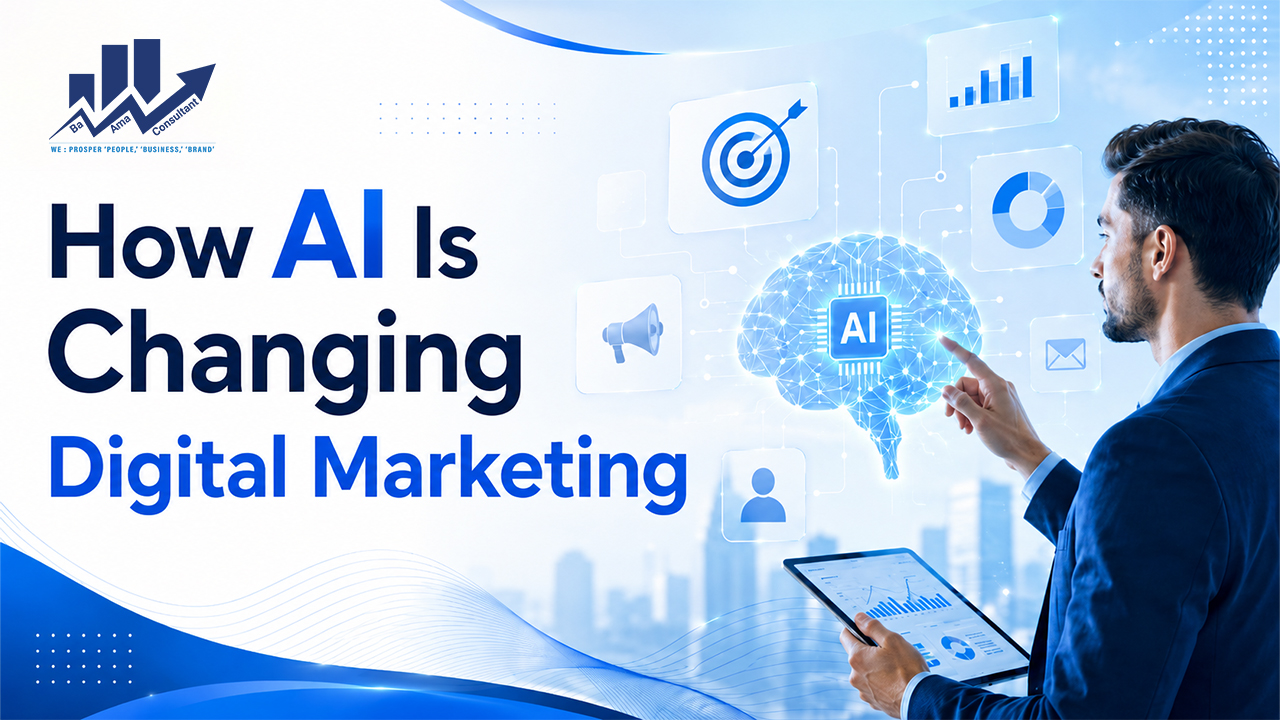
Artificial intelligence is changing how businesses plan, create, measure, and improve digital marketing. From content research and SEO to paid advertising, customer communication, social media planning, and reporting, AI can help marketing teams work faster and make better-informed decisions.
However, AI is not a replacement for business strategy, customer understanding, human creativity, or ethical marketing. The real value of AI in digital marketing comes when businesses use it to improve quality, relevance, speed, and decision-making rather than simply producing more content.
For businesses investing in digital marketing in Nepal, AI creates new opportunities to understand customers better, create useful content in Nepali and English, improve search visibility, and respond faster to customer inquiries. But success still depends on trust, clear messaging, accurate information, and consistent execution.
What Does AI Mean in Digital Marketing?
AI in digital marketing refers to the use of machine learning, generative AI, automation, and predictive systems to support marketing activities.
These tools can help businesses analyse large amounts of data, identify patterns, suggest ideas, personalise messages, improve campaign targeting, and reduce repetitive work.
For example, AI can support a marketing team by helping them:
- Research customer questions and search intent
- Generate first drafts for blogs, captions, scripts, and advertisements
- Analyse website traffic and campaign performance
- Suggest keyword clusters for SEO content
- Segment audiences for personalised campaigns
- Improve ad creative testing
- Summarise customer feedback and reviews
- Support faster responses through chatbots and automated workflows
The important word is support. AI can produce ideas and patterns, but people must verify facts, understand local culture, protect customer data, and make strategic decisions.
Why AI Matters for Digital Marketing in Nepal
Nepal’s digital audience is large, mobile-first, and increasingly active across Google, Facebook, Instagram, TikTok, YouTube, Messenger, and WhatsApp. DataReportal estimated that Nepal had 16.6 million internet users by late 2025, equal to 56% internet penetration. It also reported 14.8 million social media user identities, equivalent to 50% of the total population.
This means many customers now search online before deciding where to study, which clinic to visit, which service provider to trust, or which business to contact.
| Digital Reality in Nepal | What It Means for Businesses |
|---|---|
| 16.6 million internet users | Customers are actively researching online |
| 14.8 million social media user identities | Social media is important for visibility and trust |
| 32.4 million mobile connections | Mobile-friendly websites and content are essential |
| Customers use multiple languages | Nepali, English, and Roman Nepali content can improve relevance |
For a local business, AI can help analyse the questions customers ask in search engines, review comments, social media messages, sales calls, and feedback forms. This can make content more useful and customer communication more focused.
A restaurant may learn that customers care most about location, parking, menu pricing, and ambience. A hospital may find that patients need clearer information about services, doctors, appointments, and treatment processes. A training institute may discover that students want answers about eligibility, fees, career opportunities, and class schedules.
AI can help identify these patterns, but a human marketer must convert the findings into trustworthy content and practical business action.
How Is AI Changing Digital Marketing?
AI is changing digital marketing in five major areas: research, content, search, advertising, and customer experience.
| Marketing Area | How AI Helps | Human Role |
| Market research | Finds patterns in customer questions and reviews | Interpret business context |
| SEO | Suggests keyword topics and content gaps | Create useful, accurate content |
| Social media | Helps plan posts, captions, scripts, and reporting | Protect brand voice and community trust |
| Paid advertising | Supports audience targeting and creative testing | Set goals, budgets, and quality controls |
| Analytics | Summarises campaign data and trends | Make strategic decisions |
| Customer support | Assists with FAQs and initial responses | Handle complex or sensitive conversations |
The businesses that benefit most are not necessarily those using the most AI tools. They are the ones that connect AI-supported work with a clear business objective.
For example, a clinic may want more appointment inquiries. A consultancy may want qualified business leads. A college may want student applications. A retail business may want repeat customers.
AI should support these goals, not distract the team with unnecessary tools, generic content, or vanity metrics.
How AI Is Improving SEO in Nepal
AI is changing the way marketers approach keyword research, technical SEO, content planning, and search performance analysis.
Traditional SEO often focused heavily on placing one target keyword repeatedly on a page. Modern SEO is more focused on search intent, topic depth, user experience, trust signals, and useful answers.
This is especially important for businesses working on SEO in Nepal. Customers may search in English, Nepali, Roman Nepali, or mixed language queries. They may search by location, service, price, problem, review, or comparison.
For example, instead of targeting only “digital marketing agency,” a business should also understand related search questions such as:
- Which digital marketing services are useful for small businesses in Nepal?
- How does SEO help a business get Google leads?
- What does a social media manager in Nepal do?
- Is Google Ads better than SEO for quick leads?
- How can a clinic improve local search visibility?
AI tools can help organise these questions into topic clusters. But the final article should answer them with practical examples, original insights, and clear information.
Google’s guidance remains clear: helpful, reliable, people-first content is more important than content created primarily to manipulate rankings. Google also recommends clear sourcing, original analysis, author background, and accurate information.
AI, AEO, GEO, and Search Visibility
AEO means Answer Engine Optimization, while GEO means Generative Engine Optimization. These terms are commonly used to describe improving visibility in AI-powered search experiences.
However, businesses should avoid treating AEO or GEO as separate shortcuts.
Google states that its core SEO best practices remain relevant for AI features such as AI Overviews and AI Mode. It does not require a special “AI ranking trick.” Pages still need to be crawlable, technically sound, useful, reliable, and focused on answering real user questions.
For BaAma Consultant, this means every article should include:
- A direct answer near the beginning
- Clear question-based headings
- Short paragraphs and readable language
- Practical examples for Nepal businesses
- Real author information
- Relevant internal links
- Updated facts and source references where needed
- Useful FAQs with direct answers
- Structured data such as Article, FAQ, Organization, and Breadcrumb schema
This approach supports traditional Google rankings as well as AI-assisted discovery.
For a deeper understanding of search visibility, businesses can explore BaAma’s guide on SEO in Nepal.
How AI Is Changing Content Marketing
Content marketing is one of the areas most affected by generative AI.
AI can help marketers brainstorm blog topics, create outlines, generate social media captions, write video scripts, summarise reports, improve grammar, and repurpose long videos into short content ideas.
But AI-generated content should not be published without review.
A generic article may sound professional but still fail to answer the customer’s actual question. It may also miss local context, use incorrect facts, repeat common information, or sound unlike the brand.
The best process is:
- Use AI to research and organise ideas.
- Add real customer questions from sales, messages, reviews, and meetings.
- Include original examples from business experience.
- Fact-check important claims.
- Edit the language for the actual audience.
- Publish content that helps customers make better decisions.
For example, a healthcare brand should not use AI to make medical claims without qualified review. A financial company should not publish investment advice without verification. A training business should clearly explain course eligibility, outcomes, fees, and limitations.
AI makes writing faster. Human expertise makes content trustworthy.
How AI Is Changing Social Media Marketing
Social media platforms move quickly. A social media manager in Nepal often has to plan content, create captions, coordinate designers, prepare video scripts, reply to messages, monitor comments, review results, and report performance.
AI can reduce the repetitive part of this work.
It can help prepare content calendars, generate caption options, suggest hooks for short videos, identify repeated customer questions, summarise campaign performance, and create different message variations for different audiences.
For example, a business may create one core educational idea and adapt it into:
- A Facebook carousel post
- An Instagram Reel script
- A TikTok video concept
- A LinkedIn thought-leadership post
- A blog section
- A customer email
- A frequently asked question
This improves efficiency, but content should still feel local and human.
Nepali audiences often respond better when content includes relatable examples, familiar language, clear visuals, realistic promises, and easy ways to ask questions. A post written only for algorithms may get views but fail to build trust.
Effective social media marketing in Nepal should connect content with community management, lead response, website experience, reviews, and business goals.
How AI Is Changing Paid Advertising
AI is increasingly used in Google Ads, Meta Ads, campaign bidding, audience signals, creative testing, and performance reporting.
This can help businesses test different messages faster and identify which campaigns are more likely to generate useful actions such as calls, form submissions, website visits, appointments, or purchases.
However, AI-powered advertising does not mean “set it and forget it.”
A business still needs:
- Clear campaign objectives
- Accurate conversion tracking
- Realistic budgets
- Strong landing pages
- High-quality creatives
- A reliable sales follow-up process
- Regular review of lead quality
For example, a campaign may generate many messages but very few serious leads. AI may optimise toward lower-cost messages unless the business tracks which inquiries actually become customers.
This is why businesses should measure more than reach, clicks, likes, or impressions. They should monitor qualified leads, appointment bookings, sales conversations, conversion rates, cost per lead, and customer retention.
A digital marketing agency should use AI to improve campaign learning, not hide poor performance behind complicated reports.
How AI Is Improving Customer Experience
AI can make customer communication faster when used carefully.
Businesses can use chatbots and automated response systems to answer basic questions such as office hours, location, services, pricing ranges, appointment processes, course details, or document requirements.
This is useful because many customers expect a quick response.
However, chatbots should not replace human support for complex, emotional, urgent, financial, or healthcare-related questions. Customers should always have a clear option to speak with a person.
A good AI-assisted customer journey looks like this:
| Customer Stage | AI Support | Human Responsibility |
| Awareness | Suggests relevant content topics | Create credible messaging |
| Research | Provides FAQ answers and website guidance | Keep information updated |
| Inquiry | Gives immediate basic responses | Follow up personally |
| Decision | Helps organise lead data | Address objections and build trust |
| Retention | Supports reminders and feedback analysis | Build genuine relationships |
The goal is not to automate every conversation. The goal is to reduce waiting time while keeping service personal.
Risks of Using AI in Digital Marketing
AI can be useful, but it also creates risks when used without quality control.
1. Incorrect Information
AI can produce inaccurate, outdated, or misleading information. Every important business claim, statistic, medical statement, price, or policy should be verified before publishing.
2. Generic Content
Publishing large volumes of similar AI-written posts can make a brand sound repetitive. It may also create weak content that does not offer original value.
3. Privacy Concerns
Businesses should avoid uploading confidential customer records, patient details, financial data, private contracts, or sensitive business information into tools without understanding privacy controls.
4. Weak Brand Voice
A brand can lose its personality when every caption, email, and blog sounds automated. AI drafts should be edited to match the company’s actual voice and customer expectations.
5. Over-Reliance on Automation
AI can identify patterns, but it cannot fully understand customer emotion, local culture, business relationships, reputation risk, or long-term brand strategy.
The strongest approach is human-led, AI-assisted marketing.
A Practical 90-Day AI Marketing Plan for Businesses
Businesses do not need to adopt every AI tool at once. A focused 90-day plan is more effective.
First 30 Days: Build the Foundation
Start by reviewing your business goals, target customers, website, social media channels, customer questions, and lead process.
Identify the top 20 questions customers ask before buying. These questions can become blogs, short videos, FAQs, landing-page sections, and social media posts.
Review whether your website clearly explains your services, location, pricing approach, contact process, proof, and next steps.
Days 31–60: Improve Content and Search Visibility
Create a content cluster around one important business topic.
For example, a digital marketing agency may create articles about SEO, content marketing, Google Ads, social media strategy, website conversion, local SEO, analytics, and AI marketing.
Use AI to organise topics, but add real examples, original explanations, and local context.
Businesses can also connect this article with related internal resources, including BaAma’s guide to types of digital marketing and its overview of digital marketing in Nepal.
Days 61–90: Test, Measure, and Improve
Use analytics to review what users are doing.
Track:
- Organic traffic from Google
- Search impressions and clicks
- Website form submissions
- Calls and messages
- Social media inquiries
- Cost per qualified lead
- Conversion from lead to customer
- Top-performing content topics
- Frequently asked customer questions
Then improve the pages, campaigns, captions, and FAQs that are already showing potential.
The best AI strategy is not about using more tools. It is about improving what already matters to the customer.
How Should Businesses Choose a Digital Marketing Agency?
A reliable digital marketing agency should not promise instant Google rankings, guaranteed sales, or unrealistic results.
Instead, it should ask practical questions about your goals, audience, offers, sales process, competitors, budget, existing website, and measurement system.
Look for an agency that can explain:
- What it will do
- Why the strategy fits your business
- Which metrics matter
- How performance will be reported
- What results may take time
- What information and support it needs from your team
BaAma Consultant works with businesses through digital marketing, branding, business strategy, and training support. Its approach should focus on building a connected system rather than isolated activities such as random posting or boosting every post.
For consultation related to AI-supported SEO, content, social media, or marketing strategy, businesses can contact BaAma Consultant.
Frequently Asked Questions
How is AI changing digital marketing?
AI is changing digital marketing by helping businesses research customers, create content drafts, analyse performance, personalise messages, improve SEO planning, automate repetitive tasks, and optimise advertising campaigns. Human review is still essential for strategy, accuracy, ethics, and brand voice.
Can AI replace digital marketers?
No. AI can support digital marketers, but it cannot fully replace human strategy, creativity, customer understanding, cultural awareness, relationship-building, and decision-making. The best results come from human-led, AI-assisted marketing.
Does AI help with SEO in Nepal?
Yes. AI can help identify keyword clusters, customer questions, content gaps, technical issues, and reporting trends. However, SEO success still depends on useful content, technical website quality, trust signals, local relevance, and user experience.
Is AI-generated content good for Google ranking?
AI-generated content can be useful when it is accurate, original, helpful, reviewed by humans, and created for users. Publishing large volumes of low-quality or repetitive AI content can harm trust and may not perform well in search.
How can a social media manager in Nepal use AI?
A social media manager can use AI to plan content calendars, create caption drafts, generate video hooks, repurpose content, analyse comments, prepare reports, and identify frequently asked questions. Every final post should still be checked for brand tone, accuracy, and cultural relevance.
What is the difference between SEO, AEO, and GEO?
SEO focuses on improving visibility in search engines. AEO focuses on making content easy for answer engines to understand and cite. GEO focuses on visibility in generative AI search experiences. In practice, strong SEO fundamentals, helpful content, clear structure, and accurate information support all three.
Should small businesses use AI for marketing?
Yes, but they should start with practical use cases such as content planning, customer FAQ analysis, reporting, email drafts, and social media assistance. Businesses should avoid depending on AI without strategy, review, or privacy controls.
Final Thoughts
AI is changing digital marketing by making research, content creation, analysis, and automation faster. But technology alone does not create trust, leads, or long-term growth.
For businesses in Nepal, the strongest approach is to combine AI-supported efficiency with human expertise, local market understanding, clear messaging, ethical practice, and measurable marketing goals.
The future of digital marketing is not AI replacing marketers. It is skilled marketers using AI responsibly to create more useful, relevant, and customer focused experiences.